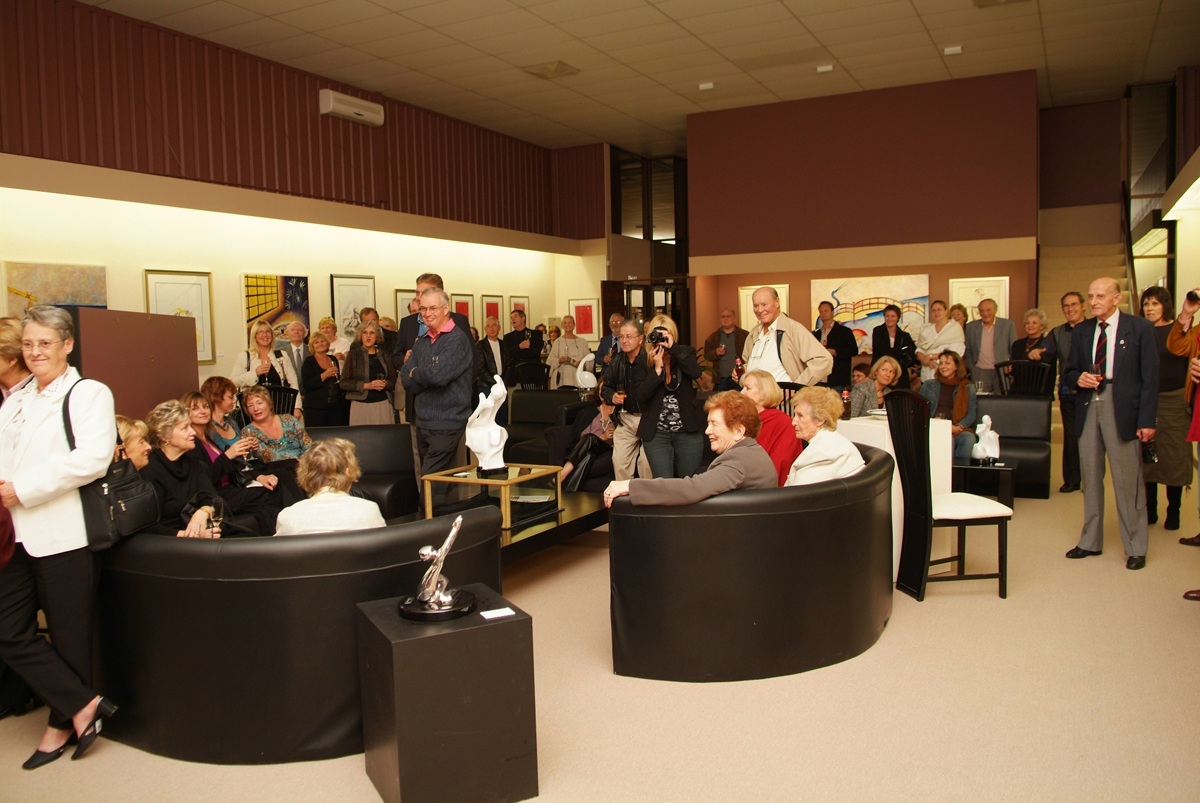
A number of years ago I was invited to an exhibition opening at a lovely gallery – I arrived a little late, went in search of sustenance, then proceeded to make my way meticulously around the gallery so i didnt miss one piece, I eventually wandered into an alcove, glass of champagne in hand, quite taken with the work on the walls as I made my way slowly around the gallery.
The paintings were lovely.
The lighting was perfect.
The atmosphere was suitably artistic.
So completely absorbed in the exhibition – I made a rookie mistake.
Now, I’d hate for you to think I was new at this.
Far from it.
I’ve attended enough openings over the years to know the basic rules of gallery navigation.
Always keep an eye on the drinks table.
Never stand directly in front of the prize-winning artwork.
And under no circumstances wander into an alcove with only one exit.
Unfortunately, on this particular evening, I became negligent.
I was trapped.
Coming in behind me was a woman who looked remarkably like one of my old art tutors from art school. With no obvious escape route and barely enough room for the two of us, I felt compelled to say something.
After all, there is such a thing as good manners.
“Lovely work,” I murmured quietly, trying not to disturb the ambience.
This, as it turned out, was my second mistake.
The floodgates opened.
Within seconds I was being regaled with every art term I thought I had left behind at art school.
Liminality.
Juxtaposition.
The interrogation of space.
The dialogue between object and observer.
The negotiation of form.
The relationship between presence and absence.
At one point I became fairly certain that a perfectly innocent flower pot was being interrogated by a bowl of fruit.
The difficulty was that while she was speaking, another entirely separate event was taking place.
There was music playing in my head.
Not loudly enough to be rude, but enough that some of what was being said simply failed to arrive. It may even have been a better conversation.
Words like liminality, juxtaposition and interrogation drifted past me like leaves floating down a creek.
I would catch every third word.
The rest disappeared somewhere between the champagne and the string quartet.
At the same time, I was attempting the complex social calculation required to escape politely.
This involved locating a possible exit route, identifying anyone I knew in the room and trying to attract their attention without appearing desperate.
Why is it that at these functions there is never a single person you know when you need one?
Hundreds of people.
Not one familiar face.
Meanwhile, I was nodding enthusiastically and attempting to look deeply engaged in a conversation I was only partially receiving.
It’s surprisingly difficult.
One must maintain eye contact.
One must occasionally murmur things like “interesting” and “absolutely”.
One must avoid looking over the speaker’s shoulder in search of rescue.
And one must not make a sudden dash for freedom.
All while internally humming along to whatever tune has decided to take up residence in one’s head.
What she didn’t realise was that while she was discussing liminality, juxtaposition and the interrogation of space, I was actually planning a sky.
A rather good sky, as it turned out.
I was mentally rearranging clouds, adjusting colours and wondering whether the horizon line needed lowering by an inch or two.
Not once did liminality make an appearance.
Nor did juxtaposition.
The sky seemed perfectly capable of getting on with things without either of them.
Eventually I broke free and made it into the fresh air and the safety of the drinks table, where I took sufficient refreshment to steady myself.
Relieved, I turned around.
Oh good grief! She had followed me out. I briefly considered leaving through a window.
What followed was an extended tour of the entire exhibition accompanied by a running commentary on the liminal, juxtaposed and interrogated qualities of virtually every object in the room.
Finally, through a combination of luck, determination and what I believe was a strategically timed canapé, I made my escape and headed for the exit.
By the time I got home, I had a solution for the painting, a slight headache and a considerably enlarged vocabulary.
Only one of those proved useful.
That evening proved something to me.
Plain English is my preferred language.
If you ask me what I paint, I’ll tell you.
I paint weather.
I paint clouds.
I paint trees.
I paint that feeling when you’re standing alone in a landscape and everything is silent.
It may not sound particularly academic, but everyone knows what I’m talking about.
And, surprisingly, they don’t get that glazed look in their eyes when I say it.
Stay Connected
Receive occasional updates on new paintings, exhibitions, studio news and stories from The Art Diaries.